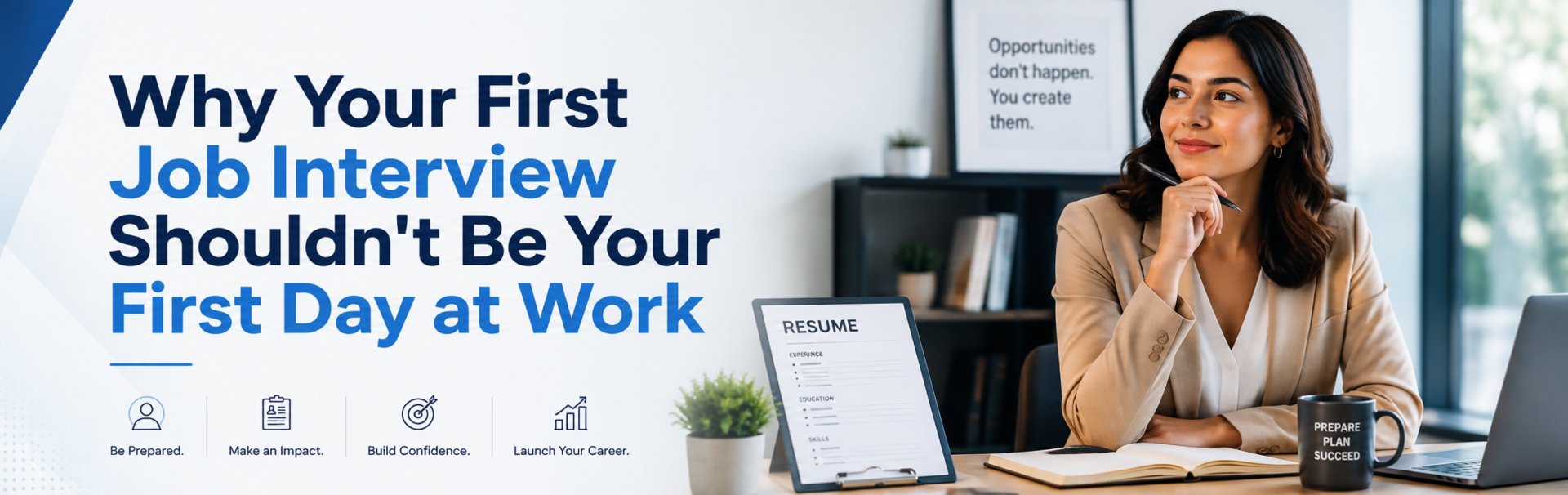
Why Your First Job Interview Shouldn’t Be Your First Day at Work
The world your degree is preparing you for rewards proof of work over promises of potential. The graduates who thrive are the ones who arrive with a track record already built.
There is a quiet assumption built into the way most of us are taught to think about higher education. You study for three or four years, you collect a degree, and then, only then, you walk into your first real workplace and begin the actual work of learning how to work. The first interview becomes the first serious test. The first job becomes the first classroom that truly counts. And for a great many freshers, the first day at work is the first time that everything they learned in theory finally meets reality.
It is a model that made sense in a slower economy. It makes far less sense in this one. When companies can see a candidate’s real output before they hire, a transcript alone stops being persuasive. The question employers are really asking has shifted from what did you study to what have you actually done.
The experience gap nobody warns you about
Recruiters have a phrase they rarely say to a fresher’s face: day-one ready. It describes the graduate who can contribute from the first week rather than being trained from scratch over the first year. Businesses increasingly want that person, because onboarding a completely inexperienced hire is expensive and slow. Yet the traditional degree hands graduates the opposite: a strong grasp of concepts and almost no lived experience of applying them.
This creates the oldest trap in the job market. You need experience to get a job, but you need a job to get experience. Freshers spend months circling that contradiction, sending out applications for roles that quietly expect the very thing a classroom-only degree could never give them. The interview is where the gap becomes visible, and by then it is usually too late to close it.
What it means to have already worked
Consider how differently an interview unfolds when a candidate has genuinely done the work. They do not speak in abstractions. They talk about a campaign they helped run, a financial model they built, a deadline they managed, a piece of feedback that changed how they approached a problem. They describe how a real project shipped, what went wrong, and what they would do differently. That specificity is impossible to fake, and interviewers can hear it instantly.
A candidate who has worked also carries something harder to name: professional composure. They understand how a team communicates, how priorities shift, how to ask for help without losing credibility. None of this is taught in a lecture hall. All of it is learned by being inside a working organisation, ideally long before the stakes of a full-time job arrive.
The work-study answer
This is exactly the problem that Sricity International University was designed to solve. Through its work-study model, students earn while they learn and engage with real companies from Year 1, rather than waiting for a single internship squeezed into a final semester. Learning and application grow together across the full course, so the classroom concept from Monday can be tested in a real workplace within the same week.
The result is a graduate who has, in effect, already interviewed the world of work and passed. By the time they sit across from a recruiter, their first day at a company is years behind them. They arrive with proof already in hand. At SIU, students begin earning a monthly internship stipend of at least ₹10,000 from Year 1, with the amount increasing progressively as they advance.
Employers notice this difference within minutes. A candidate who can walk into a room and discuss the mechanics of a real project speaks with an authority that no amount of exam preparation can imitate. They ask sharper questions, because they have watched how decisions actually get made. They stay calm under pressure, because they have already worked to deadlines that carried real consequences. A recruiter is not simply hiring a set of marks; they are hiring a person who can be trusted with responsibility. That trust is far easier to extend to someone who has already earned it inside a real organisation than to someone who has only promised it on a page.
Why this matters most for business careers
Nowhere is applied experience more valuable than in business. A student in the BBA in Finance and Accounting who has read real balance sheets and built working models is worth far more to an employer than one who has only studied theory. A student in the BBA in Digital Marketing and Communications who has run live campaigns for real brands walks in with a portfolio, not just a certificate. In these fields, judgment is built by doing, and the graduates who have done it are the ones who get hired first.
Your first interview should be a conversation about work you have already done, not a nervous audition for work you have never attempted. That single shift, from learning then working to learning while working, is the difference between entering the job market hoping and entering it already ahead.
Admissions 2026-27 are open at Sricity International University. Explore the BBA in Finance & Accounting and the BBA in Digital Marketing & Communications at www.thesiu.org, or call +91 89777 63331 / +91 89777 63332 to speak with our admissions team.
Related posts
-
Earning While Learning: How Paid Internships Change the Economics of a Degree
A degree is one of the largest investments most families ever make. When that degree pays you while...
20 August 2026 -
AI Can Write Your Resume. Can It Get You the Job?
For most of the last century, education and employment ran in sequence. That sequence is being replaced by...
10 September 2026 -
The Gig Economy Is Coming for Freshers. Here’s How to Graduate Already Ahead of It.
The world your degree is preparing you for rewards proof of work over promises of potential. The graduates...

7 August 2026